
An Epic Day of Birdwatching in Khao Yai National Park on the Birdwatching Trips ‘The Spoonful of Thailand Tour’
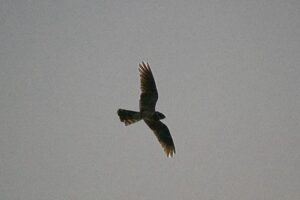
Large-tailed Nightjar, photo by Phil Woollen
After exploring the vibrant wetlands and forest to the south west of Bangkok, we’ve now ventured northeast to the breathtaking Khao Yai National Park. This UNESCO World Heritage Site, Thailand’s first national park established in 1962, spans over 2,000 square kilometers of lush evergreen forests, grasslands, and mountains. It’s a biodiversity hotspot, home to more than 300 bird species and a wealth of mammals, including endangered ones. Our day here was nothing short of spectacular, blending early-morning thrills with non-stop avian discoveries.
The day kicked off bright and early, or rather, dark and early, for the most dedicated birders (and a few insomniacs) in the group. We gathered at 5:15 a.m. to hunt for owls, armed with a thermal imager that quickly proved its worth. It detected a large mammal lurking in the nearby forest, its long ears and horns revealing it as a Mainland Serow (Capricornis sumatraensis). This goat-antelope species is globally threatened, classified as Vulnerable by the IUCN due to habitat loss and poaching, making our sighting a rare treat.
As dawn approached, we heard the distinctive calls of an Asian Barred Owlet (Glaucidium cuculoides), followed by a superb view of a Brown Boobook (Ninox scutulata), this cryptic Asian owl perched atop a nearby dead tree. Large-tailed Nightjars (Caprimulgus macrurus) echoed around us with their eerie calls. The thermal imager even spotlighted a bright heat source that turned out to be a massive swarm of bees, nature’s way of reminding us that not every glow in the dark is a bird!
After a hearty breakfast, the full group headed into Khao Yai. We hadn’t even fully entered the park gates when we stumbled into what felt like the birding jackpot: an incredible 30 minutes packed with stunners. First up, a pair of Long-tailed Broadbills (Psarisomus dalhousiae) treated us to stunning close-up views, their vibrant green and blue plumage flashing in the morning light. These broadbills are known for their elaborate hanging nests and are a favorite among birders for their acrobatic foraging.
Then, a male Banded Kingfisher (Lacedo pulchella) began calling overhead, perching just above eye-level for prolonged observation, its striking black-and-white bands and rufous chest a highlight. The near-endemic Cambodian Flowerpecker (Dicaeum cambodianum), restricted to parts of Thailand and Cambodia, almost played second fiddle as a fine male sang nearby. To top it off, we spotted both Red-headed (Trogon erythrocephalus) and Orange-breasted Trogons (Harpactes oreskios) together, alongside a Heart-spotted Woodpecker (Hemicircus canente). This whirlwind of color and activity showcased Khao Yai’s rich lowland forest ecosystem, where trogons, often called “jewels of the forest” thrive on insects and small fruits.
Our first proper stop was at a serene forest campsite, where a herd of Sambar Deer (Rusa unicolor) grazed peacefully. These large deer, the biggest in Southeast Asia, are a key prey species for big cats in the park (though we didn’t spot any big cats today). Adding to the reptilian drama, a massive Water Monitor Lizard (Varanus salvator) lumbered by, joined by a Common Butterfly Lizard (Leiolepis belliana) and a Gliding Lizard (Draco spp.), the latter famous for its ability to “fly” between trees using skin flaps.
Birdwise, a Shikra (Accipiter badius), a small hawk akin to a sparrowhawk, perched prominently for scope views. Several Moustached Barbets (Psilopogon incognitus) called from treetops, their fruity voices a staple of Asian forests. An Oriental Honey Buzzard (Pernis ptilorhynchus) soared low overhead, while small flocks of Hill Mynas (Gracula religiosa), known for their mimicry skills—passed by, adding glossy black and yellow accents to the canopy.
We pressed on uphill to Haew Suwat Waterfall, famously featured in Leonardo DiCaprio’s film The Beach (2000). While the cascading waters were picturesque, our focus remained on the birds. A Greater Flameback Woodpecker (Chrysocolaptes lucidus) finally showed itself after some searching, its flame-like back markings earning its name. We also ticked off trickier species like the Puff-throated Bulbul (Alophoixus pallidus), with its distinctive throat puff, and the Swinhoe’s (or Brown-throated) Minivet (Pericrocotus cantonensis.
These birds highlight Khao Yai’s layered habitats, from dense understory to open woodlands, supporting a mix of resident and migratory species.
A well-deserved lunch break came next, under the watchful eyes of a troop of Pig-tailed Macaques (Macaca nemestrina). These bold primates, often seen raiding crops outside the park, provided comic relief with their antics. Nearby, Pileated Gibbons (Hylobates pileatus) filled the air with their whooping territorial calls—a symphony that’s both haunting and exhilarating. Gibbons are monogamous and highly arboreal, with their songs helping maintain family bonds in the dense forest.
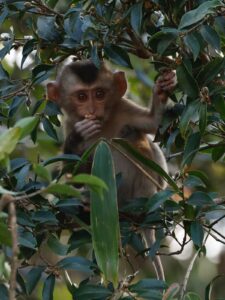
Pig-tailed Macaque, photo by Phil Woollen
Post-lunch, we birded around the restaurant area. Forest Wagtails (Dendronanthus indicus), winter migrants from Siberia, bobbed along in a patch of leaves. A Crested Serpent Eagle (Spilornis cheela) dramatic swooped down to snatch prey just yards away, a reminder of the park’s healthy raptor population. The local subspecies of Blue Rock Thrush (Monticola solitarius philippensis), with its vivid blue plumage, perched stoically, observing the bustle.
Climbing by minibus to Pha Diew Dai viewpoint at over 1,000 meters, the birding grew more challenging in the montane forest. But rewards came thick and fast: a displaying Black Eagle (Ictinaetus malaiensis) and an eye-level flyby of Great Hornbills and a Wreathed Hornbil, whose massive casques make them icons of Asian rainforests. We honed our identification skills separating Alström’s Warbler (Phylloscopus soror) and Marten’s Warbler , while a Claudia’s Leaf Warbler (Phylloscopus claudiae) zipped through a mixed flock. A splash of color arrived with a brief White-throated Rock Thrush (Monticola gularis), but the Hill Blue Flycatcher (Cyornis whitei) stole the show, posing openly in its electric blue glory.

Hill Blue Flycatcher, photo by Phil Woollen
As we descended, wild Red Junglefowl (Gallus gallus), ancestors of domestic chickens scratched roadside. At a lake overlook, Germain’s /Himalayan Swiftlets (Aerodramus germani) and Asian Palm Swifts (Cypsiurus balasiensis) hawked insects, joined suddenly by seven Brown-backed Needletails (Hirundapus giganteus)—massive swifts that can reach speeds over 100 km/h.
The day capped with mammal magic: the group spotted a Northern Red Muntjac (Muntiacus vaginalis), a small barking deer. While watching, three Malayan Porcupines (Hystrix brachyura) ambled by nonchalantly. But the second bus claimed “mammal of the day” honors with a point-blank encounter of a bull Asian Elephant (Elephas maximus) at sunset, a majestic, Endangered giant that roams Khao Yai’s core zones.

Malay Porcupine, photo by Phil Woollen
In total, we logged 113 bird species today, an astonishing haul for a single forest site, pushing our trip list to 313 birds and 26 mammals. Khao Yai’s diversity underscores its importance for conservation, protecting everything from tiny flowerpeckers to massive elephants amid Thailand’s rapid development.
Tomorrow, we delve deeper into the park and surrounds. An “early” 6:45 a.m. breakfast counts as a lie-in after today’s dawn start.