
Costa Rica come and join us – super birds, super lodges!
[center][b]COSTA RICA – Quetzals and more!
8th – 24th November 2014[/b][/center]
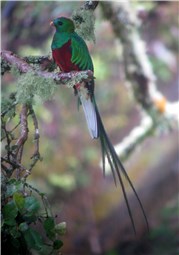
Male Resplendant Quetzal – number one bird in Costa Rica?
Why Costa Rica? Well, the outrageously beautiful quetzals, great lodges, and friendly people are just some of the reasons why people come back to Costa Rica again and again. This tiny Central American country has more than its share of beautiful scenery, not to mention a rich assortment of birds unequalled by any other country of its size. Our tour visits Rainforest, Cloud Forest, Humid Forest, Pre-montane Forest, Dry Forest and Mangrove Forest giving a wide range of exciting species. We hope to enjoy over 300 species of bird on this amazing tour. Cost is £2,795 per person excluding flights. Below we set out our plan for this amazing tour and give details of the lovely places where we will stay. Come and join us.
[b]Hotel Bougainvillea, San Jose[/b]
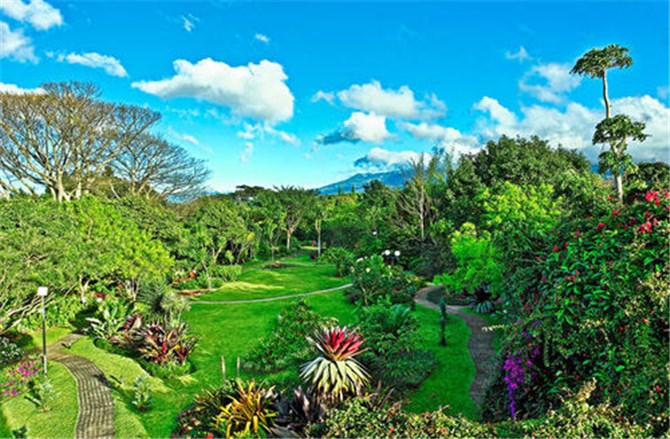
The hotel has bird filled gardens.
Intro
Hotel Bougainvillea is the perfect place to start and end a Costa Rica birding tour. It is conveniently located only 15 to 30 minutes from the airport, in a quiet residential neighbourhood surrounded by a large garden full of beautiful flowers, birds and butterflies.
Hotel facilities
Hotel Bougainvillea offers 77 spacious standard rooms and 4 junior suites. All rooms are modern and are elegantly furnished. Room amenities include flatscreen Cable TV, air conditioning, ceiling fan, safety deposit box and a sitting area on a private terrace with either garden views or panoramic views of the Central Valley. All bathrooms have been recently renovated, have stylish sinks and showers and include a hairdryer. The hotel is located in a 4 ha well maintained garden, exclusively accessible by hotel guests. There is a swimming pool, souvenir shop and even a tennis court. The restaurant serves delicious Costa Rican and international dishes and there is a well-stocked bar. Free Wireless internet is available in the rooms and in the common areas.
Birding and wildlife highlights
Besides being the ideal place to relax after or before a long international flight, Hotel Bougainvillea is probably the best birding spot in the whole San José metropolitan area. The beautiful gardens dotted with tropical representatives like heliconias, gingers, bromeliads and even orchids attract many butterflies and some of the more common birds of Costa Rica. A morning birdwalk here is the ideal introduction to birdwatching in Costa Rica; the birding is relatively easy and can produce the beautiful Blue-crowned Motmot, Rufous-tailed Hummingbirds, Squirrel Cuckoo, Crimson-fronted Parakeets, Hoffman’s Woodpeckers, Great Kiskadeee, Tropical Kingbird and Social Flycatcher, House Wren, Rufous-naped Wren, Blue-gray and Palm Tanagers, and Grayish and Buff-throated Saltator. A little harder are the Rufous-capped Warbler and Plain Wren. Hotel Bougainvillea is known to be a good spot for the local Prevost-ground Sparrow and White-eared Ground-sparrow. These skulkers can be hard to see tough, especially the Prevost Ground-sparrow. Try to look low in the thick vegetation in the centre of the garden. Also Ferruginous Pygmy Owl can be around sometimes and at night the Common Paurques become active in the car park. A Tropical Screech-owl can sometimes be heard at night and used to have a stake-out in the large bamboo thicket in the garden. Ask the gardeners if they have seen the owl lately (La lechuza ).
[b]Evergreen Lodge, Tortuguero, Caribbean coast[/b]
Intro
Evergreen is located in the north-eastern corner of Tortuguero, 5 minutes by boat from the main entrance to Tortuguero National Park, and accessible only by air and water. Evergreen Lodge is the ideal location from which to explore this unique and magical area, surrounded by towering trees and exuberant vegetation and are adorned with tropical designs.
Facilities
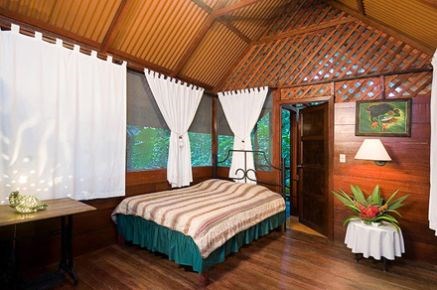
This lovely lodge has 55 comfortable rooms, all are spacious, with comfortable beds, private bathrooms, hot water, and ceiling fans, swimming pool. The property has an excellent restaurant and bar. The beautiful main dining room with soaring ceilings provides first class meals in an atmosphere that reflects and compliments the jungle paradise surrounding it. The lodge is just 8 minutes from Tortuguero National Park main entrance in the Penitencia canal.
Birding and wildlife highlights
The Tortuguero National Park is the most important area in the western Caribbean for the green turtle nesting (Chelonia mydas). One of the main reasons for creating the park was the preservation of this reptile; four of the seven species of sea turtles in the world come to spawn in the northern caribbean beaches: hawksbill (Eretmochelys imbricata), the brown loggerhead (Caretta caretta) and the leatherback (Dermochelys coriacea), and furthermore the popular green turtle.
Tortuguero National Park was created in 1975 and is a RAMSAR site of international importance. This covers an area of 26156 ha. (65390 acres) on the land and has approximately 50160 ha (125400 acres) of water. Its tropical rain forests are mostly primary and receives approximately 4500 a 6000 mm. of precipitation per year, where there are species such as the jaguar, tapir, three-toed sloth, three of the four species of monkeys that are in the country, plus manatees, crocodiles, gaspar fish among others. The full diversity of species is largely reflected in its inhabitants where approximately 400 species of trees reside, more than 2200 species of plants and over [b]405 species of birds[/b].
[b]Selva Verde Lodge, Caribbean Lowland[/b]
Intro
Selva Verde Lodge is a classic among the Costa Rica birding lodges. The lodge is immersed deep in the tropical rainforest, giving direct access to great birding habitat the moment you step out of your room. Expect to be overwhelmed by up to 3 species of toucans and other colourful birds of Costa Rica like Tanagers, Motmots and Trogons. In addition, Selva Verde Lodge is the ideal base to explore the Sarapiqui biodiversity area and to observe the spectacular avifauna of the Caribbean lowlands. This is a must-visit lodge on any Costa Rica birding trip.
Facilities
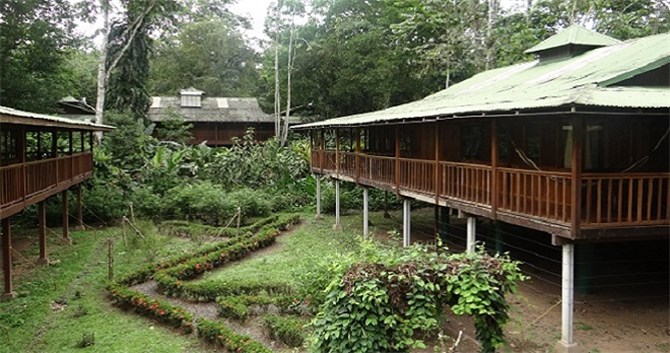
About 40 spacious rooms are nicely integrated into the tropical environment, interconnected by wooden walkways covered with a roof, quite practical in this humid environment. An extensive trail system passes through primary and secondary rainforest and a botanical garden with collections of heliconias and gingers attracting many hummingbirds. There are 2 restaurants: the buffet restaurant and an “a la carte” restaurant serving tasty Italian dishes using fresh and local ingredients. Besides that there is a bar from where one can enjoy the beautiful views of the Sarapiqui Rivier. From both the bar and restaurant, you can enjoy the view of the fruit -feeders where Montezuma Oropendolas, and several toucan and tanager species come to feast on bananas and papayas. This is the ideal spot to get close to some of the most beautiful birds of Costa Rica, and a favourite place for photographers. There is also a swimming pool here.
Birding and wildlife highlights
The immediate surroundings of Selva Verde Lodge give a good introduction to the diverse avifauna of the Caribbean lowlands. Expect to get overwhelmed here as there are just so many birds…. This is probably one of the most productive areas for birdwatching in Costa Rica. The feeders offer easy birding; Chestnut-mandibled Toucans, Gray-headed Chachalacas, Passerini’s, Blue-gray and Palm Tanagers, Collared Aracaris, Olive-backed Euphonias, Montezuma Oropendolas and Black-cheeked Woodpeckers are the most common. Now and then Keel-billed Toucan and Red-throated Ant-tanager might show up, Orange-billed Sparrow often feeds on the ground to pick up leftovers. The birding is also easy around the Sarapiqui Rivier. Amazon, Ringed and Green Kingfisher should be around. Early morning and late afternoon are good times to see Cattle Egrets, Snowy Egrets, Little Blue Herons, Tricolored Herons and Neotropic Cormorants fly back and forth. But Selva Verde is most famous for often being a good place for both Sunbittern and Fasciated Tiger-heron, often seen foraging around the rocks in the Sarapiqui river.
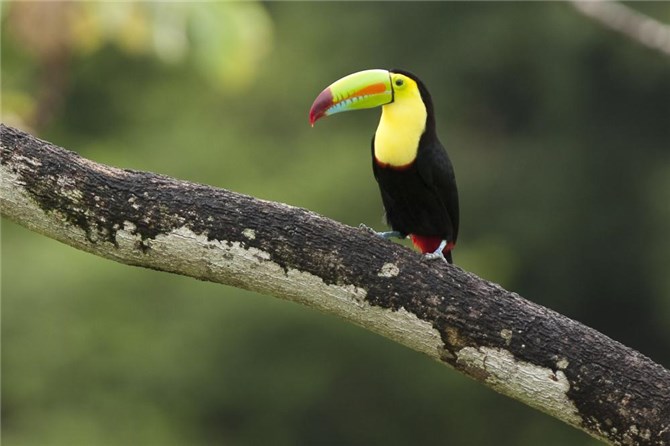
Keel-billed Toucans will always bring a smile to your face.
The trails give access to some good rainforest habitat where some of the harder forest birds can be seen like Slaty-tailed Trogon, Broad-billed and Rufous Motmot, Pale-billed Woodpecker, and Semiplumbeous Hawk and where the smaller passerines tend to hang out in mixed-species flocks with Plain-brown Woodcreeper, Northern Barred Woodcreeper, Cocoa Woodcreeper, Wedge-billed Woodcreeper, Plain Xenops, Chestnut-backed Antbird, White-breasted Wood-wren and Lesser Greenlet. Leks of White-collared Manakins should be around. Besides that the forest edge and garden area might produce White-crowned, Brown-hooded, Mealy and Red-lored Parrots, Crimson-fronted, Orange-chinned and Olive-throated Parakeets, Masked and Black-crowned Tityras, Yellow-crowned Euphonias, Golden-hooded Tanagers, Crested Guans, and many more…But Selva Verde Lodge is also one of the best places to spot Great Green Macaws, often seen flying over and Snowy Cotinga; an elusive bird that can show up anywhere anytime…Several species of hummingbirds hang out around the heliconias and gingers at the botanical garden including Rufous-tailed Hummingbird, Bronze-tailed Plumeleteer, Scaly-breasted Hummingbird, White-necked Jacobin and sometimes even the spectacular Black-crested Coquette. At night, Short-tailed Nighthawks can be sought around open areas; they are both reported in the botanical garden and around the Sarapiqui River. Crested Owls, Common and Great Potoo can be heard sometimes at the forest edge…seeing them is hard…
Besides birds in Selva Verde one can see both Mantled Howler Monkeys and White-faced Capuchin Monkeys. Both Black-and-green Poison Dart Frog and Strawberry Poison Dart Frogs are common on the grounds of the lodge; especially after a heavy rain these frogs become very active. Green Iguanas and Emerald Basilisk live in the forests around the lodge and are quite easy to spot. At night a lot other species of frogs become active; the world-famous Red-eyed leaf-frog is easy to spot in a pond near the restaurant…
[b]Hotel Savegre, Highlands[/b]
Intro
Hotel Savegre is one of the classics among the Costa Rica birding lodges, located in the beautiful cloudforest scenery in the heart of the Talamanca mountains. Hotel Savegre can be found on most Costa Rica birdwatching itineraries because of the unique avifauna found in its surroundings. The hotel has been run since its inception by the friendly Chacón familiy, pioneers in the area who do a great job offering a top-quality service that goes hand in hand with the environment.
Hotel facilities
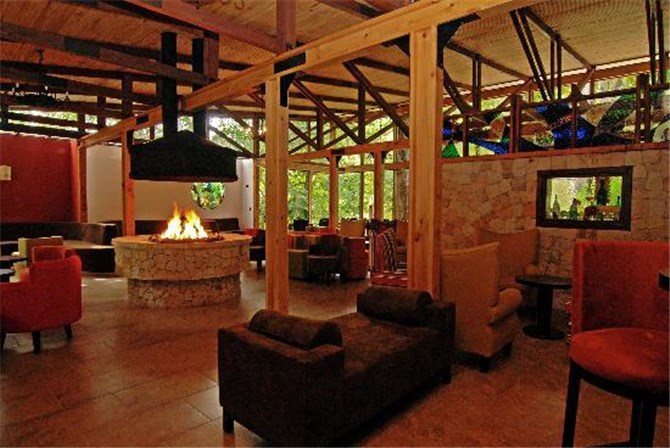
Hotel Savegre offers 41 rooms: 21 standard and 29 Junior Suites all surrounded by beautiful gardens and at the edge of the cloudforest. There is a good restaurant combining international cuisine with the best of traditional Costa Rican dishes. The recent addition of a spacious lounge with cozy sitting areas near a fireplace and a well-stocked bar is the ideal place to relax after a day of birding. There is an extensive trail system with 30 km of well-maintained trails through their own private 400 ha nature-reserve bordering Parque Nacional Los Quetzales. These trails are exclusively accessible for hotel guests. The “Del Rio Spa” offers an extensive menu of services including massages, body wraps, exfoliations and facial treatments and has a sauna, steambath and 2 jacuzzis!!
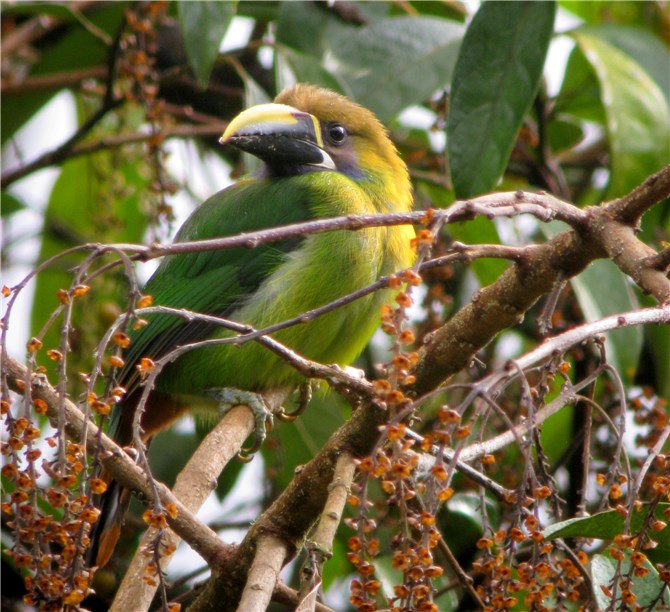
Emerald Toucanets can be seen around the lodge.
Birding and wildlife highlights
San Gerardo de Dota is known as the most reliable place in the country to observe the Resplendent Quetzal, probably the most famous bird of Costa Rica and maybe of the entire Western Hemisphere. It is often found feeding in a fruiting wild avocado tree, the quetzal’s favourite food. Besides quetzals other large frugivores like Black Guans and Emerald Toucanets can also be expected here. Another aspect the San Gerardo de Dota area is famous for is the uniqueness of its avifauna. Many of the birds that one can see here are endemic to the mountains of Costa Rica and Panama and cannot be found anywhere else in the world. In the flowery garden right in front of your room one can already do some easy birdwatching. Especially early morning around 6:00 am many birds gather around the lampposts to feast on the moths sitting around them. Here you can see Yellow-thighed Finch, Collared Redstart, Yellow-winged Vireos, Sooty-capped Bush-tanagers, Silver-throated Tanagers, Flame-colored Tanager and Slaty Flowerpiercers. Acorn Woodpeckers are very common in the trees surrounding the restaurant. At the sugarfeeders all day long one can enjoy intense hummingbird activity with Green Violetears, Magnificent Hummingbird, White-throated Mountain-gem, and the tiny Scintillant and Volcano Hummingbird. Stripe-tailed Hummingbird can be seen often fouraging around bright flowers in the hotel garden. Large groups of Sulfour-winged Parakeets are seen frequently flying through the valley; Red-tailed Hawks and Swallow-tailed Kites often soar above the hotel grounds . A walk along the picturesque Savegre River can produce American Dippers, Torrent Tyrannulet and Louisiana Waterthrush (during northern winter). The forest trails allows you to penetrate the beautiful interior of the cloudforest. Birds are a bit harder to spot here and most move around in mixed species flocks including Spot-crowned Woodcreepers, Ruddy Treerunners, Tufted Flycatcher, Mountain Elaenia, Brown-capped and Yellow-winged Vireos, Ochraceous Wren, Gray-breasted Wood-wren, Yellow-thighed Finch, Collared Redstarts (very common), Flame-throated Warbler, Black-cheeked Warbler, Sooty-capped Bush-tanager, Black-faced Solitaires and Ruddy-capped Nightingale-thrushes. A little harder are Streak-breasted Treehunters, Buffy Tuftedcheeks, Hairy Woodpecker, Spotted Barbtail, Golden-bellied Flycatcher, Olive-striped Flycatcher and the timid Chestnut-capped Brush-finches. Highly recommended is a visit to the “los robles” trail where one can walk in an impressive old oak forest with giant oaks of which some are more than 60 m tall. The scenery is already a great attraction here, but this forest is also known to hold some of the local specialities like the tiny Costa Rican Pygmy-owl and the rare Silvery-throated Jays, and the Spotted Woodquails…..
[b]Macaw Lodge, border of dry northwest and Pacific lowlands[/b]
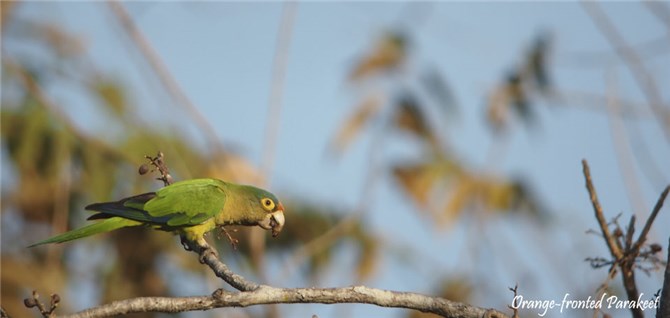
Parakeets like this Orange-fronted Parakeet will be high on our wanted list.
Intro
Macaw Lodge is located between two life zones, the humid tropical forest and the high humidity pre-montane forest, between expanses of rural roads, pastures, mature and secondary forests, and organic farming plots. These bioclimatic, ecological, and landscape conditions provide an abundance of birds that can easily surpass 350 species of migratory and resident birds of the lower and upper regions of the Central Pacific. Of these, more than half have been identified on the property.
Facilities
Macaw Lodge offers a place to relax to the rhythm of nature. The rooms and cabins, which were carefully designed and built not to disrupt the natural harmony of the surroundings, accommodate up to 28 people, a real eco-lodge. Each of the 8 rooms in the main building has two full beds, a ceiling fan, and a private bathroom built from marble extracted and processed locally, solar heated water, towels and bed sheets made from bamboo fibre, therapeutic mattresses and bedspreads woven by the Maya of the Guatemalan Atitlan area. The screen windows in the rooms and bathrooms are made of a special brass mesh that makes it possible to enjoy the breeze in the comfort of the room.
Visitors’ Reviews on Tripadvisor:
This place is something else! Its peacefulness and quiet is just incredible. You sleep to the sound of frogs and wake up with birds! Loved it! Pablo the owner is such an interesting person and he really loves and takes great care of his property. I loved the fact that he is a tico, which adds to it.
The service was impeccable, the rooms were neat and beds were extra comfortable. Food was excellent and super tasty. Make sure not to miss the walk to the waterfall 🙂
M. Matheos, August 2014
If I could give Macaw Lodge an extra star, I would! It’s a rustic but elegant, beautifully landscaped eco-oasis in the middle of some of the most beautiful forest you’ll find, Central Pacific! First of all I researched this trip well in advance. I first became aware of the Macaw Lodge when my son, Otto, who is a bird watcher specialist in Costa Rica, invited me to participate in a bird monitoring tour.I was really impressed with how the owners, Pablo and his family, had crafted this beautiful eco-resort from the ground up over many years taking into account the input of their guests and the desire to preserve the environment. So I decided to go check things out. What started out to be research turned out to be one of the best trips I have ever been on.
The staff and service were the best we have ever experienced, specially, Pablo, who made sure we did not want for anything to the great guides for our nature and Bird watch tour. excursions.
Would I go back? Yes!! Absolutely! I wish the trip hadn’t ended too soon.
Salvador, May 2014
Birding and wildlife highlights
The garden being developed around the Lodge is a tropical botanical garden for ex situ conservation (outside its natural habitat). It features a large collection of palms from around the world that includes more than 100 different species. Plants are grouped by family, and its colourful landscape contrasts with the multiple shades of green of the natural forest that surrounds it. A walk through the garden trails reveals multiple species of aquatic plants, heliconias, and bamboo. Bromeliads are part of the existing natural environment and a great amount of them have been grouped together to highlight their importance.
While at Macaw Lodge, we spend the day at Carara National Park, one of the top birding spots in Costa Rica. Here is a trip report from an American visitor to the park in January:
My first trip was on January 5th. For those of you who are unfamiliar with this park, it lies on the superficial boundary in which the Mexican dry forest and the amazonian type rainforest meet. This leads to extreme species richness and diversity. I would classify the type of forest as moist tropical forest where ground-covering plants aren’t as common as they are in Braulio Carrillo or the Osa Peninsula.
There are two main trails: the river trail which is straight and flat. And the double loop trail which is (duh) a pair of loops. The latter has a slight elevation change in a few places. I first walked the River Trail at 6am. I saw Yellow-bellied Flycatcher, Chestnut-sided Warbler, Yellow-throated Vireo, Ruddy Quail-dove, Rufous-and-white Wren, Northern Bentbill, Black-hooded Antshrike, Dusky Antbird, Three-wattled Bellbird, Brown-hooded Parrot, Scarlet Macaw, Plain Xenops, Wedge-billed Woodcreeper, Masked Tityra, Northern Barred Woodcreeper, Dot-winged Antwren, Orange-collared Manakin, Baird’s Trogon, Common and Slate-headed Tody-flycatcher, Purple-crowned Fairy, Long-tailed and Little or Stripe-throated(same species)Hermit, Turkey, Black and King Vulture, Streaked Flycatcher, Cocoa or Buff-throated Woodcreeper, Rufous-breasted Wren, Black-bellied Wren, Black-throated Trogon, Violaceous Trogon, Black-headed Trogon, Lineated Woodpecker, Riverside Wren, Cherrie’s Tanager, Red-legged Honeycreeper, Golden-hooded, Summer and Gray-headed Tanager, White-collared Swift, Boat-billed Flycatcher. For those of you who are especially looking for the Orange-collared Manakin, one of the most coveted species in Carara, my friends and I located the Lek (courting grounds) twice once in early January and once in late March. We found it on the river trail, right hand side about 10-20 paces past the little concrete bridge that crosses the stream running through the path. Remember, only the males are orange and black. The females are leaf green, yellowish belly, wide, dark bill, orange legs, and short tail. Another sought after bird is the Scarlet Macaw. These are much easier to find. Very noisy birds that drown out other birds’ songs and calls. As for the trogons they all have very similar calls, which can be set to the rhythm of a bouncing ball, most birders are familiar with this analogy. Trogons are very sedentary so locating them by sound will help a lot.
If you start the Double –loop Trail at about 2:30 you will have about 3 hours of good light left. The first 100 meters are surrounded by dry low forest in which I saw Blue-black Grosbeak, Variable Seedeater, Barred Antshrike and Rose-throated Becard (most R-T Becards you’ll see don’t have rose throats, so don’t let that fool you. The rest of the coloration should be the same). In the thicker taller forest I saw Great Tinamou, White-winged Becard, Golden-crowned Euphonia, Black-faced Antthrush, Sulphur-rumped Flycatcher, Chestnut-backed Antbird, Buff-throated Foliage-gleaner, Plain-capped Starthroat, Ochraceous Flycatcher, Fiery-billed Aracari, Laughing Falcon and finally Chestnut-mandibled Toucan before leaving the park.
[b]Ensenada Lodge, dry northwest[/b]
Intro
La Ensenada Lodge is an isolated lodge, beautifully located in the heart of the Guanacaste province of Costa Rica. The lodge offers a fantastic setting for birding in Costa Rica with pasturelands dotted with some small patches of tropical dry forest, shrubs, some wetlands, salt ponds and extensive coastal areas with rocky beaches and mangroves. This large variety in landscapes attracts a huge variety of birds. Birdwatching in Costa Rica isn’t more relaxed than at La Ensenada Lodge, where, thanks to the many open areas, some of the most beautiful birds of Costa Rica are easy to observe and photograph.
Facilities
La Ensenada Lodge offers basic bungalows with private bathrooms. Each one has a private porch with hammocks with great views of the Pacific Ocean. Good home-made meals are served in the restaurant. There is also a well-stocked bar and wireless internet is available in the common areas. About 30 % of the large farm of which La Ensenada Lodge is part of protects important parts of tropical dry forest, mangroves and wetlands. All these habitats are accessible to hotel guests by means of an extensive and well-maintained trail system. A refreshing swimming pool is the ideal place to relax after our birding.
Birding and wildlife highlights
La Ensenada Lodge offers some of the best birdwatching in Costa Rica if you are interested in the typical avifauna of the tropical dry forest and wetlands. Because of the open habitat the birding here is quite easy. Expect to see some of the most colourful birds of Costa Rica like the Turqoise-browed Motmot, White-throated Magpie-jay, White-fronted Parrot, and Orange-fronted Parakeet. Other common birds that are easy to see around La Ensenada Lodge are Rufous-naped Wren, Hoffman’s Woodpecker, Cinnamon Hummingbird, Canivet’s Emerald, Green-breasted Mango, Yellow-headed Caracara, Crested Caracara, Eastern Meadowlark, White-tipped Dove, Inca Dove, Common Ground-dove and Melodious Blackbird. A bit harder are Scrub Euphonia, Streak-backed Oriole and Spot-breasted Oriole. The sought-after Three-wattled Bellbird is a yearly guest around La Ensenada Lodge and normally shows up around December –January. Its characteristic loud sound can be heard from a far distance. At night Common Pauraques can be seen and also Lesser Nighthawks might be around. Both Pacific Screech-owl and Ferruginous Pygmy-Owl (which is also active during the day) are common but not always easy to see.
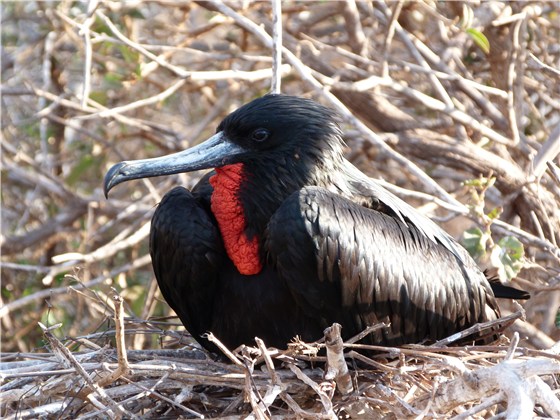
A short walk to the beach can produce a whole set of different birds. Around the pier at high tide many gulls and terns hang out. Most common are the Laughing Gulls and Royal Terns and Sandwich Tern, but other species might be around. Also common are the Brown Pelicans, Magnificent Frigatebirds, Neotropic Cormorant and White Ibis. A walk to the nearby salt flats can be very productive for sandpipers and plovers (only present during the northern winter). All species will be in their winter plumage, creating an identification challenge. Look for Spotted, Western, Semi-palmated and Stilt Sandpiper, Black-bellied Plovers, Wilson’s Plover, Semi-palmated Plover, Black-necked Stilt, Whimbrel, Willet and Short-billed Dowitchers. A nearby pond can produce Black-bellied Whistling Ducks, Blue-winged Teals, Wood Storks, Roseate Spoonbills, Great Egrets, Little Blue Herons, Tricolored Herons, Green Heron, White Ibis and Northern Jacana. Sometimes even the large Jabirú shows up. Around the reed edges Purple Gallinule and even the shy Sora may be around.
We return to San Jose and the Hotel Bougainvillea for another lovely stay before we head off to the airport for our flights home on the 23rd November landing back in the UK early morning 24th November.
We would love you to join us on this wonderful trip and we know you will love the birds and lodges of Costa Rica. To book your place or for more information please drop us a line….
This a small group tour with just six guests and three guides, including an expert local bird guide, to ensure everyone has the very best chance of seeing all the birds. We hope to see over 350 species at a relaxed pace taking time to really enjoy the birds and Costa Rica.
Alan and Ruth