

Siberian Rubythroat, photo by Phil Woollen
The final full day of our Birdwatching Trips “A Spoonful of Thailand” tour was an unforgettable dawn-to-dusk adventure in Doi Pha Hom Pok National Park, perched high in northern Thailand’s Chiang Mai province, just a few hundred metres from the Myanmar border. This remote, mountainous reserve, Thailand’s second-highest peak area, offers some of the country’s most thrilling high-elevation birding, with misty ridges, pine forests, and open roadside edges that attract rare and spectacular species.
Participants had three options: an ultra-early start (pre-dawn departure, skipping hotel breakfast) to maximise chances for the star target; a more relaxed rise with breakfast at first light and arrival by around 8 a.m.; or a complete rest day enjoying the hotel’s comforts. A dedicated group of three chose the hardcore option, leaving the hotel in the pitch dark, what felt like the middle of the night, for the long, winding drive up to the famous Doi Lang area.
The primary goal? The rare and elusive Mrs. Hume’s Pheasant (Syrmaticus humiae), a stunning, long-tailed forest pheasant that’s notoriously shy and best seen from vehicles to minimize disturbance. The male is a masterpiece: metallic chestnut body, steely blue neck and wing patches, bold white wingbars, and a dramatically long tail banded in black and white. The female, though subtler, is intricately patterned in rich browns with black-spotted upperparts and a distinctive red facial patch. To have any hope, we needed to arrive at the stakeout spot at least half an hour before first light and wait quietly inside the vehicle.
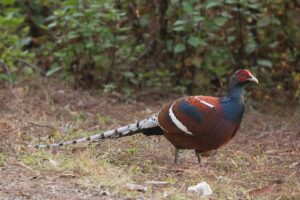
Mrs Hume’s Pheasant, photo by Phil Woollen
While we scanned patiently in the pre-dawn chill, smaller birds kept us entertained: charming Grey Bushchats, Olive-backed Pipits, a sharp-looking Grey-backed Shrike, and a gorgeous Rufous-gorgetted Flycatcher flashing its colours. Then, magic, a subtle movement along the track edge, and a breathtaking male Mrs. Hume’s Pheasant stepped confidently into view. Over the next half-hour, we were treated to incredible, prolonged sightings of a male and two females. They fed cautiously on scattered roadside seeds, edging closer and closer until we enjoyed frame-filling, almost unbelievable views through binoculars and scopes. As suddenly as they appeared, they melted back into the undergrowth, leaving us elated.

Happy birders!
The second minibus soon joined, bringing those who’d opted for breakfast and a later start. Together, we continued to the road’s end near the Myanmar border, where local birders maintain a small feeding station that acts as a magnet for colourful species.
The rewards came thick and fast. Two Scarlet-faced Liocichla, vibrant babblers with brilliant red faces, wings, and tail flashes, stole the show as they hopped boldly at the seeds. A dazzling parade followed: the deep sapphire blue of a Rufous-bellied Niltava, the fiery orange tail of a Daurian Redstart, the emerald green of a Wedge-tailed Green Pigeon, and a flurry of striped sprites; Pallas’s, Hume’s, Greenish, Davison’s, Chinese Leaf, and Yellow-browed Warblers darting through the branches.
A quick stop in a small clearing for photos of a female Slaty-blue Flycatcher produced an even bigger surprise: out of nowhere, a stunning male Siberian Rubythroat popped onto a branch just yards away, its ruby throat glowing in the morning light, what a heart-stopping moment!

Happy photographers!
New birds poured in relentlessly, a much sought-after Great Nuthatch clambering high overhead, a real target bird of this area, closely followed by Chestnut-vented and Violet-breasted Nuthatches; a cobalt-blue male Large Niltava; Pale-blue, Sapphire, Slaty-blue, and Little Pied Flycatchers; and a striking Maroon Oriole.
A scenic picnic lunch on the mountain, enjoyed while White-browed and Red-eyed Scimitar-Babblers bounced energetically in front of us, was the perfect recharge.
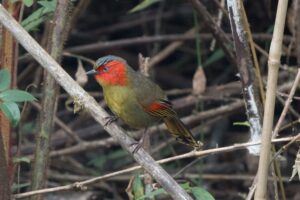
Scarlet-faced Liocichla, photo by Phil Woollen
The afternoon birding stayed relaxed, we barely moved from the same productive stretch of road. More highlights included Slender-billed Oriole, Crested Finchbill, four species of minivets, and deeper studies of tricky warblers: Aberrant Bush Warbler, Buff-throated Warbler, a Bianchi’s Warbler alongside a subtly different Martens’s Warbler. While sifting through Pallas’s and Chinese Leaf Warblers, our expert guide Jay suddenly tensed. We’d been puzzling over a small, unmarked leaf warbler when it called, Jay’s excitement was instant: “Sichuan Leaf Warbler!” A very rare vagrant in Thailand, with only a handful of records ever (our bird was roughly the eighth for the country, and Jay, one of Thailand’s top birders, had seen just one before). An absolute thrill!
We savoured the scenery, chatted, and basked in the smug satisfaction of an epic day. Along that short section of mountain road alone, we tallied an astonishing 98 species, many lifers or tour firsts for the group.
As the light faded, watching a noisy flock of Grey Treepies and a majestic White-headed Jay, our tour total reached an incredible 438 species since starting. With half a day left before our flight from Chiang Rai to Bangkok, you can bet we’ll squeeze in one last birding session, because in Thailand, the birds just keep coming!
What a way to cap off two weeks of unforgettable birding in this incredible country.